
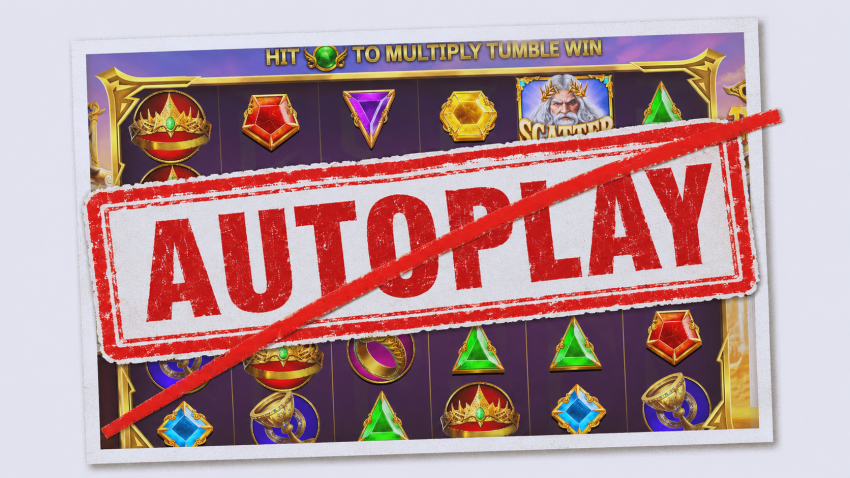
Spend any time bouncing around slots on sites outside Ontario’s regulated market and you’ll bump into a familiar little control: hit auto-play, set a number of spins, and the reels just keep going without you touching anything. Load Ontario’s regulated market and that button is gone. Not hidden in a menu somewhere, not disabled by default with an option to turn it back on. Gone, full stop.
That’s not an oversight or a quirk of one operator’s app. It’s a rule.
Ontario’s game-design requirements for online slots come from the Alcohol and Gaming Commission of Ontario’s Registrar’s Standards for Internet Gaming, and one of them is about as direct as regulatory language gets: slot suppliers aren’t allowed to offer auto-play. The relevant provision is Requirement 2 of Standard 2.16. The AGCO’s own explanation for it is straightforward — making a player manually start every spin creates a deliberate pause between wagers, and that pause gives someone a moment to actually notice what they’re doing before they do it again. According to the regulator, that small friction point helps maintain awareness and control, cuts down on long uninterrupted stretches of play, and reduces the risk of gambling-related harm.
It’s not the only rule in that neighbourhood, either. Ontario’s standards also set minimum time requirements between spins, and separately prohibit features that dress up a loss as something worth celebrating — the kind of triumphant sound or animation some games use even when a “win” pays back less than the original wager. Different requirements, same general idea: the interface shouldn’t be doing the player’s thinking for them, and it shouldn’t be nudging them toward playing faster or longer than they’d choose on their own.
None of that is new. What is current, and worth pointing at, is that the AGCO isn’t just publishing standards and hoping suppliers read them. In late August 2026, the regulator ordered $70,000 in monetary penalties against Booming Games (Malta) Limited after finding that prohibited auto-play functionality had been available to Ontario players on multiple slot titles for several months. The AGCO’s investigation concluded that Booming Games hadn’t properly configured, tested, or monitored the affected games, both before they launched in Ontario and afterward. The issue surfaced through the regulator’s own proactive compliance work rather than a complaint, and once it was flagged, the operator running those games was notified and the auto-play functionality was switched off.
The penalty covered two separate contraventions — the auto-play breach itself under Standard 2.16, and a second one under Standard 4.09 for failing to keep monitoring and testing the games throughout their lifecycle, meaning the supplier couldn’t actually demonstrate the titles were still operating the way they’d been approved to. Booming Games has the right to request a hearing before Ontario’s Licence Appeal Tribunal, so this isn’t necessarily the final word on the case. But the AGCO’s own framing of it is worth sitting with: “Ontario’s game design standards are fundamental player-protection measures built into the regulated igaming market — they are not optional technical requirements.”
That’s a useful sentence, because it’s easy to think of gambling regulation mostly in terms of who’s licensed to operate, what the tax rate is, or how self-exclusion works. Standards like this one sit somewhere less visible — inside the actual mechanics of the game you’re looking at — and they don’t get much attention until an enforcement action like this one puts a dollar figure and a company name next to them.
I’ll be honest, the manual-spin requirement is easy to find mildly annoying in the moment. Clicking a button forty times in a row is objectively less convenient than clicking it once and letting the game run. That’s sort of the point. The friction is the feature. Ontario’s standards are built on the idea that removing the pause between wagers removes a small but real opportunity to notice your own play — and the fact that a supplier can still get caught missing that requirement, on multiple titles, for months, is a decent reminder that these aren’t just words in a document nobody checks.
Slots are entertainment, not income, and no amount of research or experience changes the math underneath the game. The Responsible Gambling page has more on that, along with support options in Ontario if you ever want them.